Women Receive Waaaaay More Negative Feedback than Men Do

I don’t make a secret of the fact that I’m highly sceptical of annual performance reviews. They’re stressful, untimely, and ripe for all kinds of anxiety and mischief. The truth is most managers aren’t remotely qualified to give an effective performance evaluation. And the training to get them qualified would take much more time than most individuals and organizations are willing to invest. But that’s a topic for another blog post on another day (and I promise it’s coming).
But today I want to talk about the most vexing problem I see with performance evaluations, and that’s rampant gender and racial bias. And I mean ridiculous, shameless, clueless, and yes, sometimes flat-out disgusting bias.
How bad is it? Sister, let me tell you.
Back in 2014, a researcher called Kieren Snyder asked men and women in tech if they would be willing to share their performance reviews for a study. She received 180 reviews, 105 men and 75 women from 28 different companies. The companies ranged from large corporations to mid-sized and small organizations.
Here’s what she found.

76% of women received explicitly negative feedback, where only 2% of men did. So, for this to be true, 76% of women employees have serious issues requiring corrective feedback where only 2% of men do. Oh, and by the way, all of the participants in the study were objectively high performers.
What. The. Hell?
This finding was so shocking that Snyder went on to found a company called Textio where she created software designed to help managers “stop failing at feedback”. Recently, Textio has been publishing annual reports on the state of feedback.
And let me tell you, it’s not getting better. In fact…
It’s worse than we think.

Textio’s 2024 report revealed that women receive 22% more personality-based feedback than men. Women are far more likely to be called "collaborative", "helpful" and "nice" (ugh!) as well as "opinionated" and "abrasive".
Men, of course, are far more likely to be called "confident" and "ambitious".
What’s the difference between opinionated and confident I wonder? Or abrasive and ambitious?
In my mid-thirties, I was told I was "blunt" and "dismissive" in a performance review. And even then, I couldn’t help wondering, if I were a man, wouldn’t I simply be called direct and decisive?
Not angry enough yet?
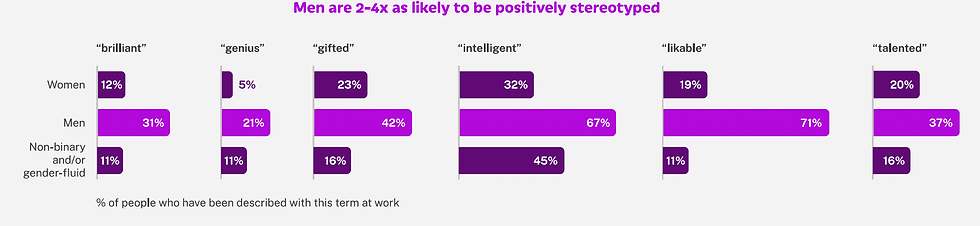
Men are 2 to 4 times more likely to be positively stereotyped. 67% of men have received feedback that they are “intelligent” as opposed to only 32% of women. And a whopping 71% of men are described as "likeable" compared to only 19% of women.
Again, this data isn’t from 1964, it’s from 2024.
And guess what else?

Textio’s 2024 report found the feedback women receive is far less actionable than that received by men. And Black and Hispanic/Latino employees of all genders are even more likely to receive actionable feedback.
So, the message is “you suck, and there’s nothing you can do about it.”
Why is this so important? (Beyond the obvious)

Well, in addition to it being frustrating and emotionally taxing on women, it also affects their income. Women receive more negative bias feedback. Women also have lower salaries as a result of that feedback because performance reviews are tied to compensation. And if you’re a Black or Latina woman, well, it’s going to be even worse for you I’m afraid because we can't forget about plain old racism.
How much of the gender pay divide is because of this?
What to do about it?
Let’s start by saying this isn’t a “man problem”. Women are writing these performance reviews too. So, start with you. Take a look at performance reviews you’ve written over the years. Have you been guilty of bias in your feedback?
Next, if you detect negative bias feedback in your performance review, sit down with your boss. Ask them to offer specific examples of the behavior they’re describing. (The boss who called me blunt and dismissive had some difficulty doing so).
And if you’re really ready to get into it, show them the Textio reports. There they will learn that leaders who rank in the top 10% on giving feedback had employees who were three times more engaged than employees with leaders scoring in the bottom 10%.
And here’s one final point.

High performing employees who get low quality feedback quit their jobs. I see it all the time in my coaching practice. So, don’t wait until performance evaluation season to give feedback. Give it often. Just ensure its relevant, timely, and given with the best of intentions.
And if you’re not receiving quality feedback, ask for it. Train your boss to give you the feedback you’re looking for. If they can’t give it to you, it might be time to move on.
Well helloooo there! Like what you see here? We'd love to have you as a member of the Expansive Woman Project. We provide content, courses, and community designed to help you take charge of your career. Membership is free, and always will be!