Building Coalitions: The Art of Organizational Influence
When I was 34 years old, I presented a business plan to the C-Suite of the media company I worked for. Up until then, the company had been in the newspaper and book industries. I proposed that we should expand our horizons and launch a gossip magazine.
The idea was a bit out there, but I’d worked on the plan for almost a year. It was creative, well-researched, well-designed, expert-scrutinized, and IMHO, well presented.
There were tough questions. I could answer them all.
Then 5:00 PM rolled around. It was a Friday. Everyone wanted to go home. That’s when Bob stood up (no disguising here, I call him Bob because that was his real name). As he moved toward the door, he said the sentence I will remember for the rest of my life, “I hate magazines and the entire magazine industry”.
Then he walked out. Bob retired that day. And that was the last sentence he said in the last meeting of the last day of his career.
That was the day I learned about organizational influence.
Maybe you’ve experienced something similar.
You've built the business case, and it's a strong one. The numbers hold up, the deck is clean, and you've rehearsed a response to every objection you can imagine. Then you walk it into the room and it goes nowhere. One person "has some concerns." Another wants to "take it offline." The decision gets deferred to a meeting and it all just fades away to nothing.
The thing about organizational influence is that it has very little to do with having the sharpest argument in the room, and almost everything to do with making sure enough of the room is already on your side before you begin.
That’s what coalition building actually comes down to: the deliberate work of lining up cross-functional support so your initiative arrives with momentum instead of landing cold. The good news is that it's a skill, which means you can get better at it on purpose.
The merit myth
So many of the capable women I coach operate on the belief that a strong enough case will carry itself. Do the work. Do it well. And you will get what you deserve.
That’s not how it works in most organizations though.
Sure, merit matters, but it’s just table stakes. The real work happens long before the boardroom meeting. It includes seeking input, advice, and concerns from anyone and everyone who could have an impact on your ability to proceed with your plan.
Yup, it will slow things down. And you might here things that you don't want to hear. But you have to think of it as an investment of time and effort because it will not only give you a more solid business plan, but it will also give you a heads up.
What objections are most likely to arise? Who and what will be affected? Who’s not on board? Who's moveable? Who’s actually excited? Which of these issues can you address now, before your formal presentation?
In other words, you need to map your terrain.
Start with a map, not a pitch
Stakeholder mapping is the unglamorous first step that separates initiatives that land from initiatives that stall, and it takes about twenty minutes with a blank page. And guess what? I have that page for you here. Download our free Influence Map Worksheet here.
Here’s what you’re going to do:
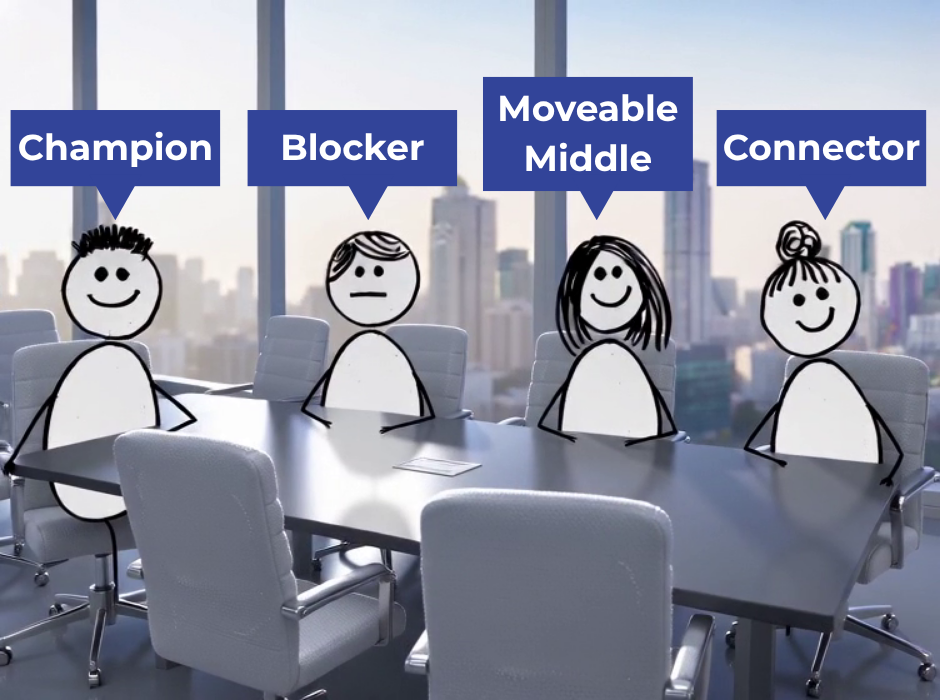
List everyone the decision touches, then sort them along two lines: how much influence they hold over the outcome, and how supportive they currently are. That gives you a handful of distinct groups, and each one calls for a different approach.
Champions
Your champions already believe in the initiative and carry real weight in the rooms that matter. Your job with them isn't to convince, it's to equip and activate. Give them the language, the one-page version, and the specific moments where you need them to speak up on your behalf, so their support actually shows up where decisions get made.
Blockers
In the example above, Bob was my blocker. And because I hadn’t mapped my terrain, he caught me completely off guard. Don’t let this happen to you.
Your blockers need to be understood before they're engaged, because a blocker with a legitimate objection is handing you free information about where your plan is actually weak. Bring them in early and privately, and treat the objection as a design input rather than an attack to survive. The blocker you converted into a contributor is worth more than the champion who was always going to say yes.
The movable middle
The people who hold real sway but haven't formed a view yet are your movable middle, and that group is usually where the initiative is genuinely won or lost. Most of your energy belongs here, not on the champions who are already sold or the blockers who may never come around. When these people say, "sure, I can get behind that" it magically settles a room full of hesitation.
Connectors
Connectors are the people whose endorsement travels. One respected connector saying "I've looked at this and it holds up" in a room you're not in will move more weight than another polished paragraph from you. Find out who they are, then make sure they understand your initiative well before the decisive conversation happens without you in it.
Stakeholder management isn't about flattering the powerful. It's about knowing, before you spend your energy, who you actually need and in what order you need them.
Remember: Influence is a set of skills, not a personality
The word influence is thrown around as if it were a trait you either have or you don't. But actually, it’s learnable.
Robert Cialdini's research on persuasion identifies six principles that reliably shift how people respond: reciprocity, liking, social proof, authority, commitment and consistency, and scarcity.
In practice, that means sequencing your conversations rather than broadcasting to everyone at once. Start with the allies who will say yes early, because visible support creates social proof for the people who are still deciding. Bring a respected skeptic in and let them shape the plan, because a person who helped build something tends to defend it later. Ask for a small, concrete commitment before you ask for the large one.
This is also where the difference between your operational and strategic networks matters. Ibarra and Mark Hunter drew that distinction in their work on how leaders build networks: operational ties are the colleagues your role naturally connects you to, while strategic ties are the people beyond your immediate remit whose support you'll need to reach broader goals.
Coalitions for cross-functional work live almost entirely in that second category, which is exactly why they don't form on their own. You have to reach those people before you need them, rather than the afternoon you're hoping for their vote.
Coalitions need maintenance, not just assembly
The coalition you build isn’t something you assemble for one project and then abandon until the next fire starts. A network you only contact when you need a favour isn't a coalition. It's a series of transactions. People notice. And they don't like it.
You have to be intentional and consistent in your network building. Close the loop and tell people what happened after they helped you. Show up for other people's initiatives when there's nothing obvious in it for you. The relationships are the real asset, and the individual wins are just what naturally follows when you respect and understand each other.
And guess what? In addition to it being beneficial to your agenda, coalition building feels good. It make the workplace less combative and more creative. It will actually make you enjoy your job more.
But isn't this overtly "political"?
Somewhere in reading this, a familiar objection may have surfaced: that all of this sounds a little political, and you'd rather just do good work and let it speak for itself.
But here’s the deal:
Politics, stripped of sneer and sneakiness, is simply how groups of people with different priorities make shared decisions. Pretending you're above it doesn't exempt you from its consequences. But it can mean you’re out of the loop when decisions are influenced and eventually made.
That said, there's also a real double standard. Women who build coalitions and advocate directly are more likely to be interpreted as "political" or "too much," while the same behaviour is seen as "strategic" and "executive presence" in their male peers.
That double bind sucks, but shrinking doesn’t help. So build your coalitions anyway, in your own way. Opting out of influence and calling it integrity is a decision too, and it's usually a decision to let other people decide on your behalf.
Where to start
It’s time to map your terrain. Download our free worksheet here.
BTW, here’s what happened in my story
So, did I get to publish my magazine?
I sure did.
Turns out though, that Bob I-Hate-Magazines was right. The magazine failed. Makes me wonder what I might have done differently if I’d spent an hour or two with Bob during the year I spent building my business plan.
I never made that mistake again.
P.S. It wasn't all bad. Here’s a picture of George Clooney reading my magazine, Weekly Scoop (yup, that’s real).