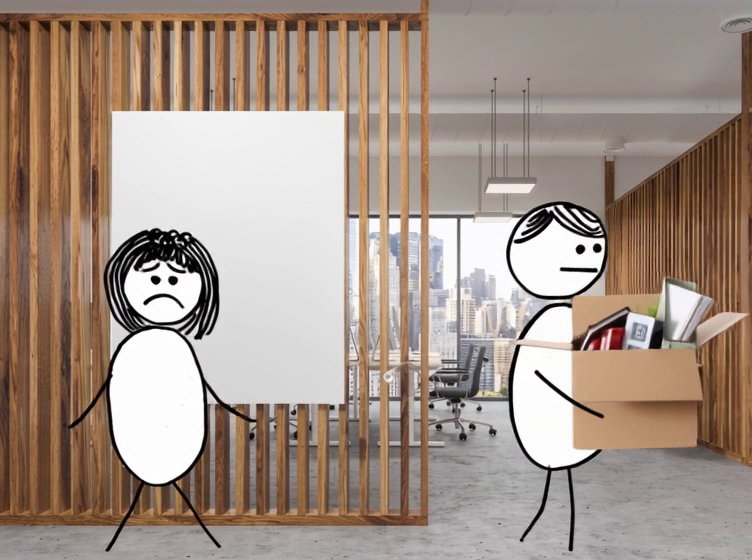
You're Leaving Your Job. What Will You Be Remembered For?

My client Joanna recently met a man who worked at a company she left more than a decade ago. Joanna had never met this man. But he seemed to know all about Joanna. In fact, he said she was "legendary" in the best sense of the word. Joanna had built a strong team. She solved problems no one wanted to take on. And she did it all with wit and joy and an astounding level of creativity.
Joanna was speechless. She had no idea she'd left that kind of legacy. But at the same time, it also made sense. She was constantly being headhunted because former colleagues were consistently recommending her. Team members from her last job applied to her new organization. People spoke well of her when they got the "so what's she really like" phone call, helping her recruit top talent with ease.
Yes, Joanna worked hard on building her network. But she also had an invisible network working just as hard for her.
That's legacy.
Somewhere in your building right now, someone is being remembered for the wrong thing. The manager who never once ran a meeting that ended on time. The VP whose entire legacy is a spreadsheet template nobody has the heart to delete. The director who is fondly recalled as "great at reply-all."
We all leave a mark. The only real question is whether we leave the one we meant to.
Chances are, in the next few years, you will change roles, change companies, get promoted out of a team, or simply move on from the project you've been holding together with tape and stubbornness for two years. Every one of those is a departure, and every departure leaves something behind.
The goal is simple to say and hard to do. Leave the place better than you found it.
So here are the three legacies you're building whether you're paying attention to them or not.
Legacy #1: The People You Developed
The most durable thing any leader leaves behind is other leaders.
In The Sponsor Effect, economist Sylvia Ann Hewlett found that senior leaders who sponsor rising talent are 53 percent more likely to land a promotion than those who don't, because you build a loyal bench, you extend your own reach, and you get things done through people who make you look good by succeeding. Sponsorship isn't charity trickling downhill. It's one of the highest-return uses of your influence you'll ever make.
Every person you develop becomes a walking, talking piece of your legacy, scattered across your industry, vouching for you for years after you've worked together. Your former team members are your references, your back channel, and your door openers.
So be deliberate. Pick two or three people whose potential you actually believe in, and spend your political capital on them in the rooms they can't enter yet. Say their names when they're not there to hear it. Hand them the stretch assignment before they feel ready, because nobody ever feels ready, including you, and you turned out fine.
Legacy #2: The Systems You Refused to Leave Broken
Most organizations run on broken systems. Though we don't call them "systems". We call them "the way things are done around here". Here are three of the most common:
Firefighting. This is when everyone's running around putting out small fires rather than addressing the underlying issue causing all the fires. Think an overburdened team required to work overtime instead of fixing the staffing problem. Or rushing out a band-aid patch to meet a product launch date that creates systemic bugs down the line. Firefighting makes everyone's job harder in the long run. Fix these issues, and you will wear that badge of honor forever.
Prioritizing personal comfort over the truth of what's actually happening. When leaders choose to save face rather than acknowledge the truth, it creates disengagement and cynicism that destroys morale and productivity. Why? Because it's crazy-making when your boss's reality is so far from what you know to be true. Do the opposite, and your team will love you for it.
Path dependence. This is when the way we do things around here becomes so ingrained that nothing new is tolerated. We end up with a team where everyone looks the same, comes from the same background, went to the same schools, or has the same degree, and call it "cultural fit". Or, we use the same data sources, or the same processes, or the same measurements, and the same tools for every problem. The result is less innovation and fewer opportunities for team members who don't fit the so-called norm.
You can’t fix every broken process, so pick the systems where you have both the standing and the receipts to change something permanently. Rewrite the promotion criteria, not just the outcome of one promotion. Fix the process of how decisions actually get made, not how they get announced. And leave a paper trail, because a legacy nobody can point to tends to evaporate on your last day.
Legacy #3: The Culture You Changed
Culture is not the values poster by the kitchen, and it is definitely not the adjectives on the recruiting page on your website. Culture is what people believe they can get away with, what ultimately gets someone promoted, and what everyone agrees to overlook as long as the person is hitting their numbers. Your real leadership values show up in the pattern of what you consistently reward and what you consistently refuse to tolerate, and the people three levels down read that pattern far more accurately than they'll ever read your all-hands slides.
This is also where meaningful work actually lives for the people you lead. It isn't in the mission statement. It's in whether the rules apply evenly, whether good work gets seen, and whether someone with less power than you felt safe telling you something true. You change culture in a thousand small, unglamorous decisions that nobody writes down, and those decisions are the residue you leave in the building long after your name has come off the door.
Answer the Question on Purpose
Most people never actually decide what they want to be remembered for at work, so the answer gets written by default, assembled from whatever they happened to tolerate and whoever they happened to help on a good day.
You're going to leave a legacy either way. The only real question is whether it'll be one you've shaped or one that was shaped for you.
Well helloooo there! Like what you see here? We'd love to have you as a member of the Expansive Woman Project. We provide content, courses, and community for women who are done waiting for their next promotion. Membership is free, and always will be!